

I Went Looking for the Edge. I Ended Up Learning to Build the Machine
Bill Benter, crypto, AI, and the Order of the Bildung.
by Harvey Vogelmann
ok so here we are. welcome.
The leverage moved
My whole life I've tried to find where the leverage is. Back in 2012–2017 I saw promise in crypto because I knew the tech was awesome, but most people either didn't know about it or laughed at it. By the time the president himself was launching a memecoin on Solana, it was a different era. I don't think crypto is done for. Agents making online payments to other agents may be a big part of its future. But I think the adoption S-curve is going to be slower.
When crypto's market cap is flat and choppy instead of always expanding with new liquidity, you have to up your game considerably. The thing I hated, hated hated, was grinding until I hit a 400x or 500x, making a stack, then grinding more and watching it chip back toward zero. I had to flat bet, like 2 SOL per trade, to survive long enough to catch those. I didn't mind being an insane vortex human-machine-learning autist vacuum of information on four hours of sleep if I printed seven figures. But three months of work ending flat or negative? Intolerable. What had I actually built in those months?
Encoding the vortex
All through my crypto journey I'd tried teaming up with developers and analysts to build blockchain analytics. What takes five minutes with an LLM today took two weeks of back and forth for a first draft with collaborating humans. In 2024, with Sonnet 3.5 and the other tools available, I started encoding patterns I'd seen.
I looked at Solana calls and asked: what if I automatically sold at 2x, 5x, 25x, or 100x? What was the difference between maximum return and the return people actually kept?
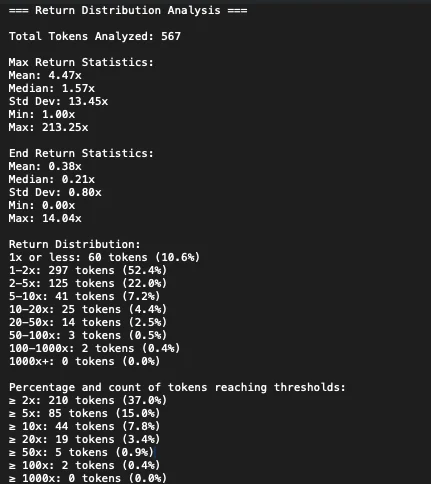
Then I started slicing. Market cap $15k–$90k or $90k–$250k? Ten to thirty holders? Five to twenty-five minutes old? One to four hours old? Eventually a developer helped me create a custom new-pairs momentum feed. I analyzed holder counts, top-wallet percentages, rates of change, market cap, and custom metrics. Billions of combinations. I went from around 300 combinations per second to 1.2 million on my stock $599 Mac mini.
Eventually I came to believe the Solana ecosystem had become negative EV for the way I was trading. Flat betting in a negative-expectancy environment wasn't the game I wanted to keep playing.
The X Pro alpha terminal
Before LLMs I used to turn X Pro, formerly TweetDeck, into a poor man's Bloomberg terminal. Custom lists updating live without refreshing the page. The magic wasn't just the live feed; it was deciding who deserved to be in it.
When a coin suddenly ran, I'd go backward and find who called it with conviction in the first hours, not the people celebrating after 50x. Then I'd watch them, promote the consistently good ones, and prune the people spraying garbage.
What if a system could do the backward research, identify early high-conviction callers, score their history, maintain those lists, and combine it with wallet analysis? That's part of what I want to automate with FOMO Ripper.
The casino math
There's an old gambler's ruin exercise. Walk into an American roulette casino, bet $1 on red every spin, and stop when you're $100 ahead or broke. What if you start with $300? What if you start with $5 billion?
| Starting bankroll | Chance of ever reaching +$100 before ruin |
|---|---|
| $300 | about 0.00266% |
| $5 billion | about 0.00266% |
Show the math
American roulette has 18 red pockets out of 38, so each $1 bet on red wins with probability p = 18/38 and loses with q = 20/38. Starting with i dollars and stopping at i + 100 or at zero, the classic gambler's-ruin result gives
P(reach +$100) = (1 − (q/p)i) / (1 − (q/p)i+100)
Because q/p = 10/9 is greater than one, both numerator and denominator are dominated by their last term, and the ratio collapses to (q/p)−100 = (0.9)100 ≈ 2.66 × 10⁻⁵. The $300 bankroll gives 0.0026561%. The $5 billion bankroll gives the same number to every digit a calculator can show. The size of the stack changes how long the ruin takes, not whether it comes.
Even an enormous bankroll doesn't make a negative-expectancy game positive. I wanted a different game.
Bill Benter and the machine
Bill Benter built models that compared estimated probabilities with public horse-racing odds. He wasn't just picking winners. He was finding mispricings and building machinery to act on them.
So on March 13 I hooked up a WebSocket to record . I sampled the first appearance of and started measuring everything I could think of. Slicing, combinations, sanitizing, validating, optimizing, rolling backtests, billions of experiments. Basically being Bill Benter with AI.
I was looking for structural anomalies in : sometimes in the tails, sometimes an intersection with something at an extreme. Because , I thought those anomalies might persist.
Anyway. I made a Bill Benter box.
Then I worked hard to make that box visually understandable. redacted · proprietary research interface, metrics, and strategy details
The actual quantitative platform is available to members of the Order. I'm not putting the operational details or demo in the public article, but the unredacted version of this chapter is available through DM.
And the funny thing is, as much as I love what I built, what I learned BUILDING it became even more infinitely priceless to me.
The real discovery: learning to build with AI

I became an AI-native systems engineer. Not someone who says “make me a bot” forty times, but someone who learns enough to direct, understand, question, and verify the work.
Design
- Product Design
- UX Design
- UI Design
- Brand Design
- Graphic Design
- Website Design
Software
- Systems Architecture
- Frontend
- Backend
- Databases
- APIs
- Git & Branching
- Dependencies
- Testing
Infrastructure
- Build Pipelines
- CI/CD
- Cloud Infrastructure
- Networking
- Observability
- Latency
Security
- Authentication
- Multi-Tenancy
- Security
Quantitative research
- Data Ingestion
- Feature Engineering
- Statistical Validation
- Execution Parity
- Risk Management
- Reconciliation
Agents
- Agent Harnesses
- Persistent Memory
- Multi-Agent Orchestration
- Human Oversight
Distribution
- Video Production
- Animation & Motion Graphics
- Image Generation
- Audio & Music Production
- Product Packaging
- Marketing Design
- Copywriting
- SEO
- User Acquisition
- Distribution
- Conversion Optimization
This tech is literal wizard power. But most people are going to be Mickey Mouse with the brooms in Fantasia. I still turn into Mickey every few days when my broom army floods the castle. I've learned how to become the senior wizard again and fix the shit.
It's not just prompting better. Imagine asking AI to make a plumbing plan for your house. Instead, ask it to teach you plumbing fundamentals, pressure, drainage, and materials, and explain the decisions as you design together. Halfway through you might say, “wait, you're assuming normal soil drainage. You know I live in Phoenix, right? In a desert?” Now you're participating in the engineering, catching assumptions and learning what questions should have been asked. Actual construction still requires qualified expertise and code compliance.
It's not just feeding the prompt to AI. It's feeding the working arrangement: skills, harnesses, context, tests, mistakes, corrections, and judgment. The finished thing is one product. The person you become capable of being afterward is another.
The community

There was a community I was in that was super valuable because it created a bunch of analytics for markets.
I got enormous value because I contributed and helped shape what they built. But if you missed a week you missed everything. I don't want that. I want the logs and repos indexed so someone can show up later, feed them to Claude, and ask, “what happened here?” I would never offer a paid group unless I thought I could top the value I got there.
The Order of the Bildung

The Order of the Bildung is up to 33 members, $222/month. I build one substantial project each month in public — public to the Order, private to the world. Members get the new project's repository, engineering conversations, custom skills, agent harnesses, workflows, and the ability to participate in shaping the project. Access to the private quantitative platform is also part of the membership offer; its private source and operational secrets stay sealed.
You don't have to watch me. Someone can engage all day and challenge a design decision. Someone else can come back at the end of the week, hand the logs to their Claude, and ask what happened. Both get value in different ways.
Month one: FOMO Ripper
The first build is FOMO Ripper, initially focused on Robinhood Chain and FOMO wallet analysis, with some of the early-caller research methods I described. Ask how a wallet performs, what would have happened if you copied it, or only copied certain market-cap, holder-count, or token-age ranges. Analyze your own wallet. Could you automate your trading journal? Could you find clusters of wallets and distinguish bots from people?
In 2025 I filtered a sample of two million Solana wallets down to around 16,000 mostly human wallets using a few filters. I don't know if the same methods work here. We'll find out. That's the point of the build. I have a second project in mind, and eventually I want the community to shape the next ones.
I'll be building roughly four hours a day given my family and AI plans. Maybe the first project is complete by month's end. Maybe it's 80% complete. You'll see the work, including the experiments that fail, and the materials remain useful.
One month can be enough
I don't expect everybody to stay. In fact, I hope a lot of people join for one month, get the repository, logs, workflows, and access to the private quantitative platform for the month, then leave if that's what fits their life. The materials they're entitled to keep can be fed to their Claude six months later when they're ready to build something. Ongoing platform access is separate.
The people who stay will help shape the projects, share their own domain knowledge, and evolve together. That's the deeper experiment. I'm not trying to make people feel obligated to pay forever. I want the first $222 month to stand on its own.
Free stuff, right now
The bigger stuff is design, not tools: isolate signing keys, separate untrusted customer text from privileged agents, keep production builds reproducible, run reviews and money-path audits, monitor every component and connection with evidence-backed heartbeats, reconcile expected versus actual balances, and make the watchdog watch itself from another machine.
- ProwlerAWS security auditOpen-source cloud security audit. Run it against your AWS account and read what it finds before anyone else does.
- OSV / OSV-Scannerknown-vulnerable dependenciesChecks your dependency tree against the Open Source Vulnerabilities database.
- Renovatedependency update PRsOpens dependency-update pull requests automatically so upgrades stay small and boring.
- HypothesisPython property-based testingProperty-based testing for Python. You describe what should always hold; it hunts for the input that breaks it.
- Codex Securityrepository security reviewRepository security review driven by an agent.
- destructive_command_guardguard against destructive shell commandsA guard that stops agents and humans from running destructive shell commands by accident.
- ultimate_bug_scannerrepo scanningRepo-wide bug scanning as a skill.
- NVIDIA SkillSpectoragent skill and plugin inspectionInspects agent skills and plugins before you install them.
- Jeffrey Emanuel's testing-fuzzing and testing-metamorphic skillsTwo skills that teach an agent to fuzz and to test by transformation rather than by fixed answers.
- Graphifycodebase graphTurns a codebase into a graph your agent can reason over.
- Cloudflare Access, Tailscale, AWS Nitro Enclaves, Healthchecks.io, Agent Mail, CASSThe plumbing behind the design points below: identity in front of every internal surface, a private network, sealed compute for keys, heartbeats with evidence, mail an agent can own, and session search.
Up to 33 members. $222 a month.